

Why T-Shape Marketing Strategy Important for Faster Business Growth

Marketing is no longer about running one Google Ads campaign, posting regularly on social media or publishing a few blogs every month. Customers today move across many channels before making a buying decision.
A customer may first discover a business through Google Search, watch a video on Instagram or YouTube, visit the website, compare competitors, read reviews, see a retargeting advertisement and finally contact the business through WhatsApp or a lead form.
This is why businesses need a connected approach to marketing. A T-shape marketing strategy brings different marketing channels together while allowing a business or marketer to develop deep expertise in one important area.
In simple words, T-shaped marketing means knowing a little about many marketing areas while becoming very strong in one or a few selected areas.
This approach is becoming increasingly important because businesses need marketers who can understand the complete customer journey instead of looking at individual channels in isolation.
Research from Revenue Marketing Alliance describes the T-shaped marketer as a specialist who also develops knowledge across other marketing fields so that they can work more effectively across teams and channels.
What is AI Marketing Automation?
AI marketing automation combines Artificial Intelligence, Machine Learning (ML), predictive analytics, customer data platforms and marketing automation software to automate and optimise marketing activities with minimal human intervention.
Unlike traditional automation, which simply follows predefined rules, AI continuously learns from customer interactions, purchasing behaviour, browsing history, campaign performance and engagement metrics. This enables it to make intelligent decisions, personalise customer experiences and improve campaign performance over time.
Imagine your marketing system working around the clock to identify your highest-value customers, predict which visitors are likely to make a purchase, recommend the right products, personalise email campaigns, optimise Google Ads bidding and automatically nurture leads until they are ready to buy. That's the power of AI marketing automation.
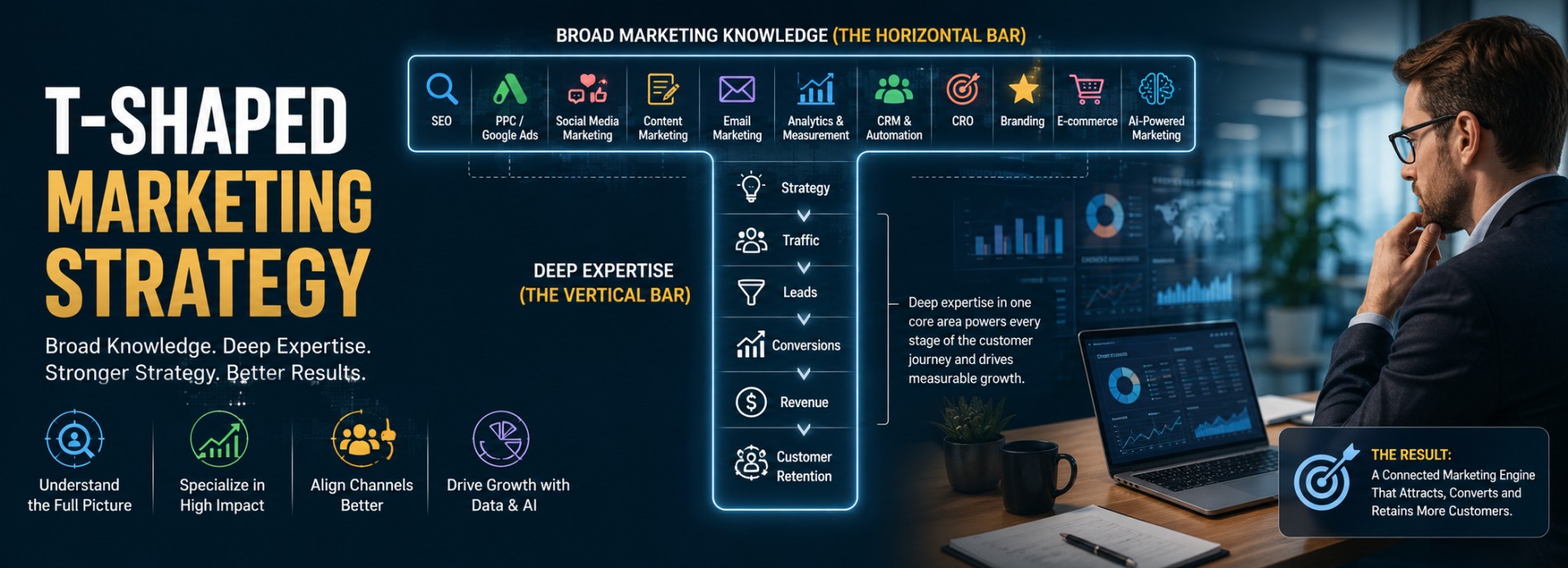
What is a T-Shape Marketing Strategy?
The horizontal line represents breadth. It includes knowledge of different marketing disciplines such as SEO, PPC, social media, content marketing, email marketing, analytics, branding, CRM, e-commerce and conversion optimization.
The vertical line represents depth. This is the area where the marketer or marketing team has advanced expertise.
For example, a performance marketing specialist may have deep knowledge of Google Ads, Meta Ads, campaign optimization and conversion tracking. At the same time, the marketer understands how SEO, content, CRM and CRO support the overall marketing funnel.
This combination creates a T-shaped marketer.
The objective is not to become an expert in every marketing channel. That is neither practical nor necessary. The objective is to understand how different channels work together and then build strong expertise in the areas that have the biggest impact on business growth.
Why is T-Shape Marketing Important for Every Business?
The biggest reason is simple: customers do not think in marketing channels.
Customers think about problems, needs, solutions, trust, price and convenience.
A business may think, "We need SEO."
The customer thinks, "I need the best digital marketing agency for my business."
A business may think, "Our Meta Ads are performing well."
The customer thinks, "Can I trust this company enough to buy from them?"
This difference is important.
A T-shape marketing strategy connects acquisition, engagement, conversion and retention instead of treating each activity as a separate project.
1. It Creates a Complete Customer Journey
A successful customer journey can involve:
When these activities work together, the business can provide a more consistent experience.
For example, SEO may bring a visitor to the website. Content can educate that visitor. Paid remarketing can bring the visitor back. CRO can improve the landing page. CRM can nurture the lead, and email automation can support retention.
That is full-funnel marketing.
It Reduces Marketing Silos
Many businesses have separate teams or specialists handling SEO, paid advertising, social media, content, and sales. While specialization is valuable, challenges can arise when these teams operate independently without a shared understanding of the overall customer journey.
The SEO team may focus primarily on improving rankings, while the PPC team concentrates on ROAS and the social media team prioritizes engagement. Meanwhile, the sales team may focus on generating and converting leads. Each team may achieve its individual targets, but the bigger question remains: Who is looking at the complete customer journey?
A T-shaped marketing approach helps solve this challenge. A T-shaped marketer develops strong expertise in one or more core areas while also having a broad understanding of other marketing channels. This enables the marketer to connect SEO, paid media, social media, content, analytics and sales toward the same overall business objective.
Instead of optimizing individual channels in isolation, the T-shaped marketer looks at how every channel contributes to the complete customer journey—from awareness and consideration to conversion, retention and revenue growth.
3. It Helps Businesses Make Better Marketing Decisions
Suppose a business is receiving 100,000 website visitors every month but generating very few sales.
A channel-focused marketer may recommend increasing traffic.
A T-shaped marketer may first ask:
This wider perspective can reveal that the problem is not traffic. It may be conversion rate, messaging, lead quality or sales follow-up.
That is the real power of a T-shaped digital marketing strategy.
The Horizontal Part of the T: Broad Marketing Knowledge
The horizontal part represents knowledge across different marketing disciplines.
A modern marketer should understand the basics of the following areas.
SEO and Organic Search
SEO helps businesses attract people who are actively searching for products, services, or information. It plays an important role in capturing demand at the moment when potential customers are already looking for solutions.
A T-shaped marketer should have a broad understanding of key SEO areas, including keyword research, search intent, technical SEO, content optimization, internal linking, local SEO and authority building. This knowledge allows the marketer to connect SEO with other channels and align organic search efforts with broader business objectives.
SEO is particularly valuable because organic visibility can continue generating traffic, leads and potential customers long after the initial content investment. When combined with paid advertising, social media, content marketing, and conversion optimization, SEO can become a sustainable source of long-term business growth.
Google Ads and Paid Search
Paid search helps businesses reach potential customers at the moment when they are actively searching for products or services. Because these users often have strong purchase intent, paid search can play an important role in generating qualified traffic, leads and sales.
A T-shaped marketer should understand the key elements of paid search, including search campaigns, keyword targeting, compelling ad copy, landing page optimization, conversion tracking, bidding strategies, and overall campaign profitability. This broader understanding helps marketers optimize not just for clicks and traffic, but for meaningful business outcomes such as conversions, revenue and return on ad spend.
Social Media and Paid Social
Social media helps businesses build brand awareness, engage with their audiences, and create a strong sense of community. It provides businesses with opportunities to communicate directly with customers, strengthen brand relationships, and remain visible throughout the customer journey.
Paid social media can further support business objectives such as lead generation, e-commerce sales, remarketing, and customer acquisition. By using audience targeting, creative content, and performance data, marketers can reach the right people at different stages of the marketing funnel.
A T-shaped marketer does not need to be an expert on every social media platform. However, they should understand how social media contributes to the overall marketing funnel and how organic and paid social activities can work together with other channels to achieve broader business goals.
Content Marketing
Content plays an important role in building awareness, educating potential customers, and supporting conversions. It helps businesses communicate their value, address customer needs and guide prospects through different stages of the buying journey.
Formats such as blogs, videos, guides, case studies, comparison pages, FAQs, and social media content can answer customer questions and provide useful information at the right time. High-quality content also helps establish credibility, demonstrate expertise and build trust with potential customers.
For a T-shaped marketer, understanding how content connects with SEO, paid advertising, social media, and conversion optimization is essential. The goal is not simply to create more content, but to create content that supports measurable business objectives and moves customers closer to conversion.
Email Marketing and CRM
Email and CRM marketing play an important role in nurturing leads, strengthening customer relationships, and improving customer retention. While acquisition channels help bring prospects into the funnel, email and CRM strategies help businesses maintain communication and guide those prospects toward conversion.
Businesses can use customer segmentation, marketing automation, and personalized communication to deliver relevant messages based on customer interests, behavior and stage in the buying journey. This enables marketers to provide the right information at the right time, improving engagement and increasing the likelihood of conversion.
For a T-shaped marketer, understanding how email and CRM connect with other marketing channels is essential. By integrating customer data, automation and personalized messaging with acquisition and conversion strategies, businesses can create a more connected and effective customer journey.
Analytics and Data
Marketing without measurement becomes guesswork.
A T-shaped marketer should understand important metrics such as:
Data helps marketers understand what is working and where the business is losing opportunities.
The Vertical Part of the T: Deep Marketing Expertise
The vertical part represents specialization.
This is where a marketer develops advanced knowledge and practical experience.
For example, a T-shaped marketer may specialize in:
Deep specialization allows the marketer to solve complex problems.
For example, someone specializing in performance marketing should be able to identify wasted advertising spend, improve campaign structure, test creative, analyze attribution, improve conversion rates and connect advertising performance with actual revenue.
The combination of marketing specialization + broad marketing knowledge creates a much stronger professional or marketing team.
T-Shape Marketing Across the Full Funnel
A good T-shape marketing strategy should cover the complete customer journey.
Awareness
The first objective of the marketing funnel is to make the target audience aware of the business, its products, or its services. At this stage, the focus is on reaching the right audience and building recognition before asking them to take a conversion-focused action.
Multiple marketing channels can contribute to awareness, including SEO, social media, video marketing, influencer marketing, public relations, and display advertising. Each channel can reach potential customers in different ways and help establish familiarity with the brand.
A T-shaped marketer should understand how these channels work together to create consistent brand visibility and attract the right audience into the marketing funnel.
Consideration
At this stage, customers are researching and comparing solutions.
Useful content includes:
Conversion
The objective is to turn interest into action.
This will be included:
Retention
Getting the first customer is only one part of the marketing journey. Businesses also need to focus on retaining customers, building long-term relationships, and increasing customer lifetime value.
Email marketing, CRM campaigns, loyalty programs, personalized offers and excellent customer service can encourage customers to make repeat purchases. These strategies help businesses stay connected with existing customers and provide relevant experiences based on their needs and preferences.
A T-shaped marketer understands that marketing does not end after conversion. By combining acquisition, retention, personalization and customer experience strategies, businesses can turn one-time buyers into loyal, repeat customers.
Advocacy
Happy and satisfied customers can become powerful brand advocates. When customers have a positive experience with a business, they are more likely to share their experiences and recommend the brand to others.
Reviews, referrals, testimonials, user-generated content, and personal recommendations can help generate additional business while also strengthening brand credibility and trust. These forms of advocacy can influence potential customers because people often value the experiences and opinions of existing customers.
This is why full-funnel marketing is more powerful than focusing only on customer acquisition. A successful marketing strategy should not stop at generating leads or sales; it should also focus on retention, customer satisfaction, loyalty and advocacy to create sustainable long-term growth.
T-Shape Marketing and AI: Why the Strategy Is Becoming More Important
AI is changing how marketers research, create, analyze and optimize campaigns.
According to HubSpot's 2025 State of Marketing research involving more than 1,700 marketers, content creation was the most commonly reported generative-AI use case at 43%. The research also found significant use of AI for research, learning and data analysis.
This means marketers increasingly need to understand both marketing and technology.
AI will help with:
But AI does not replace marketing strategy.
Someone still needs to understand the customer, business objectives, positioning, brand and commercial outcome.
This is another reason why the T-shaped marketer is becoming valuable.
T-Shape Marketing in the AI Search Era
Search is also changing rapidly.
Google's AI Overviews and AI Mode are changing how users interact with search results. Recent academic research analyzing more than 55,000 queries found that AI Overviews appeared for 13.7% of queries overall and for 64.7% of question-form queries in the study period.
Another 2026 study of browsing behavior found that clicks to cited sources within AI Overviews occurred in only about 1% of visits to AI Overviews.
For businesses, this means traditional SEO alone will not be enough.
A modern SEO and AI visibility strategy should also focus on:
This requires a broader marketing mindset.
How to Implement a T-Shape Marketing Strategy
Businesses can start with a simple five-step framework.
Step 1: Define the Business Goal
First decide what the business actually wants to achieve.
Is it:
Step 2: Map the Customer Journey
The first step in creating an effective full-funnel marketing strategy is to understand the complete customer journey. This involves identifying how customers discover the business, what influences them while evaluating its products or services, what motivates them to make a purchase, and how they interact with the brand after the purchase. Mapping each stage helps marketers identify customer needs, potential barriers, and opportunities to improve the overall experience and guide customers smoothly from awareness to loyalty.
Step 3: Identify the Core Specialization
The first step in building a strong and competitive marketing strategy is to clearly define the core specialization. This involves selecting the specific area of marketing where your skills, resources and market opportunities align most effectively—such as content marketing, performance advertising, SEO, brand strategy, or lifecycle marketing. By focusing on a well-defined specialization, you can develop deeper expertise, differentiate yourself from competitors, and deliver greater value to your target audience. Identifying this core strength also helps guide strategic decisions, ensuring that your efforts are concentrated on the areas most likely to generate sustainable competitive advantage and long-term growth.
Step 4: Build Cross-Channel Knowledge
A strong full-funnel marketing strategy requires a working understanding of how different marketing channels and disciplines connect and support each other. This includes SEO for organic visibility, paid media for scalable acquisition, content marketing for education and engagement, and social media for community building and brand awareness. It also involves CRM systems for managing customer relationships, analytics for measuring performance and uncovering insights, and CRO (conversion rate optimization) for improving the effectiveness of each touchpoint. Developing cross-channel knowledge allows marketers to create more cohesive campaigns, make data-driven decisions, and optimize the entire customer journey from awareness through retention.
Step 5: Measure Business Results
Marketing success should not be measured only through impressions, clicks, likes, or followers. While these metrics can provide useful insights into audience engagement and campaign performance, they do not always reflect the actual impact on the business.
A T-shaped marketer should connect marketing activities with meaningful business outcomes such as qualified leads, new customers, revenue, profit, customer lifetime value, and retention. By focusing on these metrics, marketers can understand which channels and strategies are genuinely contributing to business growth and make better, data-driven decisions.
A Simple Example of T-Shape Marketing
Consider a local healthcare business that wants more patient enquiries.
Instead of running these activities separately, the T-shaped approach connects them.
This creates a data-driven marketing strategy where every channel contributes to the same business objective.
Key Benefits of a T-Shape Marketing Strategy
A properly implemented T-shape strategy can help businesses:
The approach is especially useful for small and medium-sized businesses because one strong T-shaped marketing professional can understand multiple functions while bringing deep expertise in a critical growth area.
Challenges of T-Shape Marketing
T-shaped marketing does not mean trying to master every marketing channel or become an expert in everything. The marketing landscape changes too quickly, with new platforms, technologies, consumer behaviors, and strategies emerging constantly.
The biggest challenge for a T-shaped marketer is maintaining broad knowledge across multiple disciplines while continuing to develop deep expertise in a specific area. Marketers need to understand how different channels work together without spreading themselves so thin that they lose their core specialization.
A marketer should therefore avoid becoming a “jack of all trades, master of none.” The stronger approach is to build a balanced skill set that combines broad marketing knowledge with deep specialization, continuous learning, and strong commercial thinking.
The better approach is:
Businesses should also avoid evaluating every marketing channel completely independently. A campaign may appear weak when viewed in isolation but become highly valuable when its contribution to the entire customer journey is considered.
For example, a social media campaign may generate limited direct conversions but significantly increase brand awareness and assist future conversions through search, remarketing, or direct traffic. This is why T-shaped marketing requires marketers to look beyond individual channel metrics and evaluate the overall business impact.
Conclusion
The traditional approach of treating SEO, paid advertising, content, social media, and CRM as separate activities is becoming less effective. Customers experience a brand as one connected business, not as a collection of independent marketing departments. This is why the T-shaped marketing strategy is becoming increasingly important. The horizontal part of the T represents broad knowledge across marketing channels, while the vertical part represents deep expertise in a core specialization. Together, they enable marketers and marketing teams to understand the bigger picture while still delivering strong execution.
For businesses, the objective should go beyond generating more traffic, followers, or leads. The real goal is to build a connected marketing system that attracts the right audience, converts prospects, retains customers, and increases long-term revenue. In an environment shaped by AI, automation, changing search behavior, and increasingly complex customer journeys, businesses need marketers who can connect the dots across channels and focus on commercial outcomes.
Think broadly. Specialize deeply. Measure commercially. Build continuously. That is the real value of a T-shaped marketing strategy—combining strategic thinking, specialized expertise, continuous learning, and a clear focus on sustainable business growth.


DO you Need some Ideas ?
I Can Help You ...
Call/WhatsApp (+91) 62038 25984


A T-shape marketing strategy combines broad knowledge of multiple marketing channels with deep expertise in one specific marketing discipline.
It helps businesses connect SEO, paid media, content, social media, CRM, analytics and conversion optimization instead of managing each channel separately.
A T-shaped marketer has broad knowledge across marketing disciplines and deep expertise in one or more specific areas such as SEO, performance marketing, paid media or CRM.
Yes. It can be particularly useful for small businesses because a T-shaped marketer can understand multiple marketing functions while providing specialist expertise in an important growth area.
AI increases the importance of cross-channel marketing knowledge because marketers now need to understand AI-assisted content, analytics, automation, personalization and changing search experiences.
Important skills include SEO, PPC, social media, content marketing, analytics, CRM, CRO, email marketing, e-commerce, branding and AI marketing, combined with deep expertise in one core area.
A specialist focuses deeply on one discipline. A T-shaped marketer combines that depth with working knowledge of several other marketing disciplines.
Copyright © 2026 All rights reserved | Email: umeskumar@gmail.com | Call/WhatsApp: (+91) 62038 25984